
Audio guide
HAM’s audio guide provides additional information on the museum’s exhibitions and fascinating stories behind the works. The guide serves as a companion for visitors to the museum, helping them to take a closer look at the museum’s pieces and immerse themselves in the world of each work. All future audio guides will be listed on this page, so that visitors can revisit them even after an exhibition finishes.
How the audio guide works in exhibitions
You can listen to the audio guide at your own pace on your own mobile device while viewing the pieces. Scanning the QR code on the label next to a piece will take you to the audio link for that piece. The headphones symbol indicates that an audio guide is available. You can listen to the guide again, pause it, or, if you wish, read the text as it is being read out by the narrator.
You can either use your own headphones or earphones, or you can listen to the guide out loud at a lower volume, making sure you do not disturb other visitors. HAM’s staff will be happy to help you with using our audio guide. You can provide feedback on the guide during your visit or afterwards here.
Leena Luostarinen: Misfit
Immerse yourself in the Misfit exhibition through moods, ancient symbols and personal memories. The audio guide texts feature both conversations had with Leena Luostarinen and painters’ subtle interpretations of her works.
The texts have been written by visual artists Viggo Wallensköld and Eeva Lietonen, as well as metropolitan Arseni, bishop of the Orthodox Church of Finland.
Leena Luostarinen was Wallensköld’s painting instructor at the Academy of Fine Arts in the 1990s and later became a close colleague in the Finnish art world. Lietonen, in turn, approaches Luostarinen’s work from the perspective of a painter of a younger generation.
Metropolitan Arseni and Leena Luostarinen shared a decades-long friendship and a deep interest in the visual arts. Arseni curated exhibitions of Luostarinen’s work and has written extensively about her art.
Narrators of the audio guides
Finnish: Viggo Wallensköld, Eeva Lietonen, Metropolitan Arseni
Swedish and English: Anna Brear, Johan Brear
Text
The feline figures that recur in Luostarinen’s paintings are part of a visual language she developed in the early 1980s – one that weaves together animals, journeys, cultural references, and personal experience to create a distinctive painterly world.
The composition of Two rests on the relationship between three colour fields: the brown earth, the bluish-green sky, and the two rock-like animal figures. Its pared-down forms invite multiple interpretations. Depending on the moment and the viewer, the painting may evoke distance, longing, acceptance, or a sense of peace.
The two animals occupy the same landscape as if they belong together, yet an inexplicable distance separates them. They turn their gaze away from us, absorbed in their own inner worlds. Only the earth and sky remain fully open to the viewer.
The quiet centre of the painting lies in the space between the figures. Its swirling browns feel receptive, gentle, and permissive. They seem to hold an accumulation of memories, expectations, hopes, and imaginings.
We never see another person entirely as they are. Unconsciously, we project onto them our own longings, fears, and memories.
The distance between the figures separates them, but it also preserves something. The painting brings together ancient and fundamental motifs: earth, sky, animal, connection, horizon, and space. These are among the basic elements through which human beings have understood their world across centuries.
Perhaps this is what makes Two such a powerful work. It feels deeply personal, even as its imagery approaches the timeless and mythical.
Text
The painting has the recognisable structure of a landscape: there is a dark expanse of land below, the sky arching above, and a horizon line joining the two together. The title, Storm, is declarative yet open to interpretation. It may refer to a literal weather phenomenon, but also to a state of violent upheaval or disruption. A storm displaces, alters relationships, and brings into view things that might otherwise remain hidden.
The work follows its own internal logic. It can be approached in different ways: with a slow, lingering gaze, by moving erratically between details, or by focusing closely on individual elements.
Storm draws its meaning from its very elusiveness – from the way brushwork, colour, and composition form a tense configuration that seems still in the process of becoming, and resists any single reading. Embracing its own ambiguity, the painting invites multiple, simultaneous interpretations.
The dark, translucent earth, the blazing sky, and the figure in the foreground can be seen as different aspects of a single internal event. They seem to pull against one another, pressing at each other’s boundaries. The horizon rises toward the right, tilting the painting from within.
The dark figure may resemble an animal, a rock, a shadow, or a geological formation. It can be read as a living presence, or as a concentration of darkness awaiting the emergence of its final form. Yet the shadow is only one of its states – one possible level of manifestation among many.
Text
Executed in just three colours, the monumental Life and Death stands out among Luostarinen’s other works. Its meaning is not immediately apparent. The painting depicts a paved footpath, created by applying black glaze over a bright yellow ground. On this painted street surface, the artist has drawn a nine-square hopscotch grid and three French words in white chalk. Leena once recalled that the idea for the work came to her after seeing two girls playing hopscotch on a pavement in Paris.
Through the introduction of text, this familiar game is transformed into an existential meditation on life and death. A traditional hopscotch grid contains ten squares and is played by at least two people. Here, however, there are only nine squares. The tenth is the open sky, suggested by the word ciel. During the 1980s, Luostarinen began incorporating text into both the content and composition of her paintings, drawing inspiration from contemporary American art.
Leena often claimed that she “lacked imagination” and needed an impulse from observed reality before a new work could begin to take shape. Although many of the paintings she created after the 1970s depict distant places, they function less as literal representations than as distilled references. Expressive and often romantic in tone, her paintings are above all vehicles for emotion.
Text
Luostarinen first encountered the motif of the Balinese dancer during a trip to Bali. One evening, while watching a dance performance, she was captivated by its unusual choreography. The performer danced while seated, expressing the entire sequence through movements of the upper body alone.
Such a performance demands extraordinary skill and imagination. Leena described the dancer as a young boy with a scarred face, dressed in an elaborate brocade costume and headdress. Every movement appeared carefully considered, and the effect was heightened by a long, narrow red scarf that the dancer swept behind his back.
From the 1990s onwards, Luostarinen often returned to the same subjects, painting them in multiple variations. She painted at least six versions of the Balinese dancer using a variety of techniques. Although she may have made sketches during the performance, the paintings themselves were created later in Finland, either from those sketches or from memory. In this version, the artist has reduced the subject to its essentials. The setting is suggested by the simplest of means: rather than using colour to create depth, Luostarinen evokes an interior space through a few drawn lines.
Text
In the beginning of the 90s, Leena Luostarinen was my teacher at the Academy of Fine Arts in Helsinki. During our fourth year, our studio spaces were located in an old barracks building on Suomenlinna Island. Two centuries earlier, the building had served as a prison. The locals called it the ‘Rag Storehouse’ – a nickname inherited from the days when military uniforms were kept there.
We students worked independently for most of the week, but Mondays and Thursdays were teaching days. One Thursday, when Leena came to Suomenlinna, she began talking about Paris. She had been painting there at an artist residency and had discovered the most wonderful park – a genuine Chinese park. “How could there be a Chinese park in Paris?” I wondered.
Leena told us the park had stalactite grottos and waterfalls, just like in ancient Chinese paintings, and that she kept returning there to sketch. From those sketches, she began painting the park’s rocks and grottos. Had she invented the whole magical place, or had I simply failed to understand what she was describing? “You should all travel after you finish school,” Leena told us. “Apply for an artist residency or something.”
Many years later, I travelled to Paris and, quite by chance, stumbled upon Buttes Chaumont Park in the middle of the city. And there it was: mountains, grottos and waterfalls, exactly as Leena had described. I immediately realised that I had found the same Chinese park. It was all real – not a figment of her imagination after all.
Text
I have a book about Leena Luostarinen in my studio. It was written by Kuutti Lavonen in 1988. For many years, it has been a source of inspiration, relaxation, and a kind of textbook on painting. In my formative years as an artist, I would turn its pages to learn how to paint, simply by looking at the pictures. One painting in particular stayed with me: Sfax. To me, it felt like a journey to distant lands, a fairy tale, a dream of romantic adventure. It was soothing, exciting, and inspiring all at once. A good painting can be all these things at the same time. Back then, I had never seen the work in person, only as a reproduction in a book. Now, in this exhibition, I finally have the rare opportunity to stand before the original.
The painting itself is remarkably simple, built from only a handful of elements. There is land that seems to roll like waves. There are palm trees, a sky, and a crescent moon. Strong contrasts of colour animate the scene, with dark land and palms set against a luminous blue sky. A distinctive rhythm emerges from the placement of forms and the interplay of broad, planes of paint.
And yet, this simplicity is enough to create something extraordinary. The work contains all the essentials – it is almost like a lesson in the very fundamentals of what makes a painting come alive. The flowing colours and generous brushstrokes seem to move together in a kind of dance. The painting gives the impression of having come into being effortlessly. It becomes more than an image. It begins to feel like music, or poetry – an epic within itself.
The power of Leena Luostarinen’s paintings lies in their expansiveness. They are not merely pictures but immersive experiences that transport the viewer to other worlds. They are journeys, fairy tales, and dreams. They carry within them a vast accumulation of cultural memory, knowledge, and hard-won wisdom. They awaken a desire to embark on an adventure, to learn more, and to travel to distant places.
Petri Ala-Maunus and Mauno Markkula: Blazing Sky
The audio guide for the Blazing Sky exhibition explores four pieces, one pair of pieces and one series of pieces. The short guide discusses the relationship between the two painters and the landscape, and the atmosphere conveyed.
The dialogue between the pieces in the exhibition continues in the audio guide, which brings together the topics of the artists’ working methods, themes drawn from trips abroad and sources of inspiration. Despite working in two different periods, the artists’ approaches to the landscape are remarkably similar, while still clearly rooted in their own individual perspectives.
The audio guide is narrated by Anna Brear.
Text
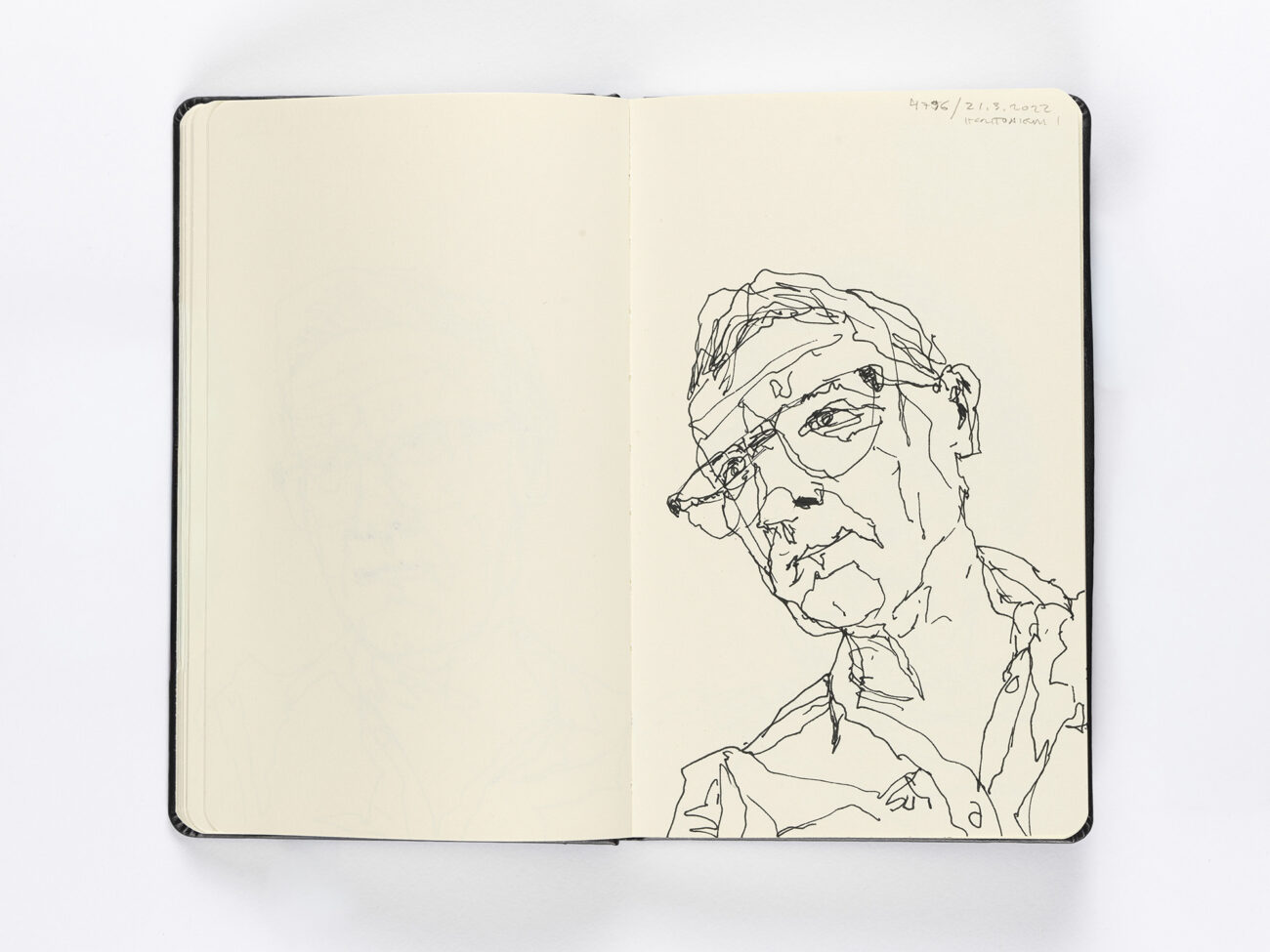
In 2017, Petri Ala-Maunus began creating daily self-portraits as a break from landscape painting. What started as a private, diary-like practice grew quietly over time, largely unplanned. Over the past nine years, he has filled a sizeable collection of sketchbooks with experimental self-portraits in a wide range of techniques. In recent years, he has devoted each sketchbook to a specific technique or concept: one, for example, the right-handed artist has drawn entirely with his left hand. These self-imposed restrictions serve as exercises, helping him stay motivated. Ala-Maunus has said that if he ever misses a day, the project will end there.
From the very first self-portrait, he has marked each image with the date and a serial number. Later, he began adding notes about where the portrait was made or about significant events of the day. Despite personal tragedies and calamitous global events, everyday life has gone on – and the sketchbooks have continued to fill, one at a time.
Each self-portrait can be read as a window into a specific moment. What was happening in the world when the artist sketched himself? What movements of the mind does the gaze conceal – or reveal?
Text
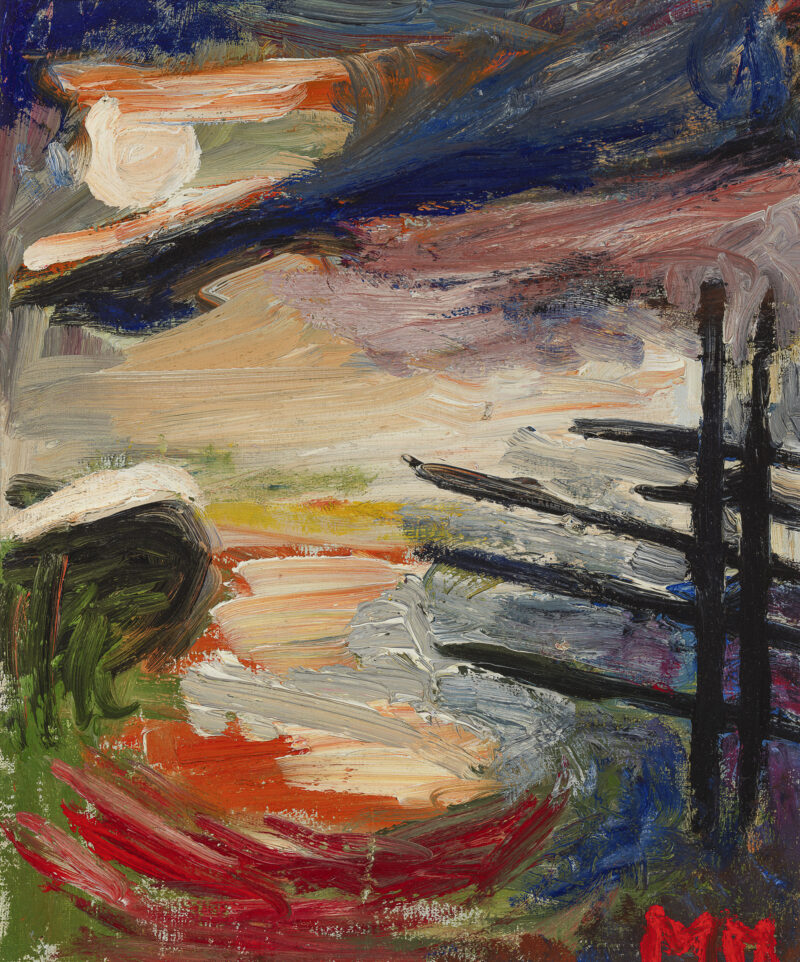
The landscapes painted by Mauno Markkula and Petri Ala-Maunus are not depictions of observed reality. They are imagined vistas, where the natural world merges with the artists’ emotional states and inner visions. When Ala-Maunus began working on the Blazing Sky exhibition, he undertook a close study of Markkula’s paintings and the texts written about him. He has spoken of his surprise at how many aspects of the late landscape painter felt familiar and deeply relatable.
For this exhibition, Ala-Maunus created twenty-nine new landscapes, each inspired directly by Markkula’s work. The paired paintings share identical titles, setting up a dialogue across time between two artists from different eras.
Viewed side by side, the works do seem to speak to one another. The basic forms of Markkula’s landscapes are echoed in Ala-Maunus’s reinterpretations. Their colours and painterly styles differ, but something essential endures. And the atmosphere – does it shift as we move from one landscape to the next?
Text
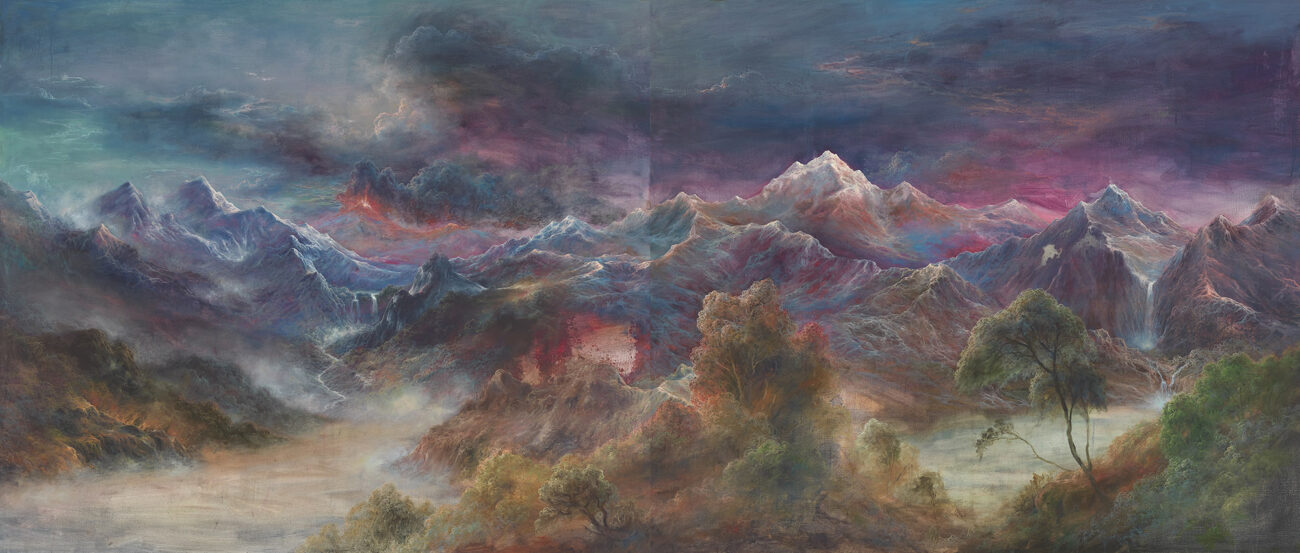
Petri Ala-Maunus painted his first landscape in 1997. Through this practice, he discovered a renewed interest in old art. A self-avowed admirer of the technical virtuosity of the old masters, Ala-Maunus describes himself as deliberately disrupting the established conventions of the landscape genre. He roams outdoors, photographing nature, but also draws from the endless flow of digital imagery. Often, he constructs his compositions from printed images, combining fragments that have lingered in his mind to create entirely new realities. His work is devoted to the pursuit of the ideal landscape – a vision that seeks to surpass even nature itself.
Ala-Maunus is known for monumental landscapes that almost overwhelm the viewer with their intensity. Measuring four metres wide, Übernatur merges snow-capped mountains, lush forests, and the menacing atmosphere of an imminent volcanic eruption. While his early landscapes included human figures, later works are strikingly devoid of people. As we observe these scenes, we are left to wonder: do these landscapes belong to a time before humans, or do they depict a post-human world?
Text
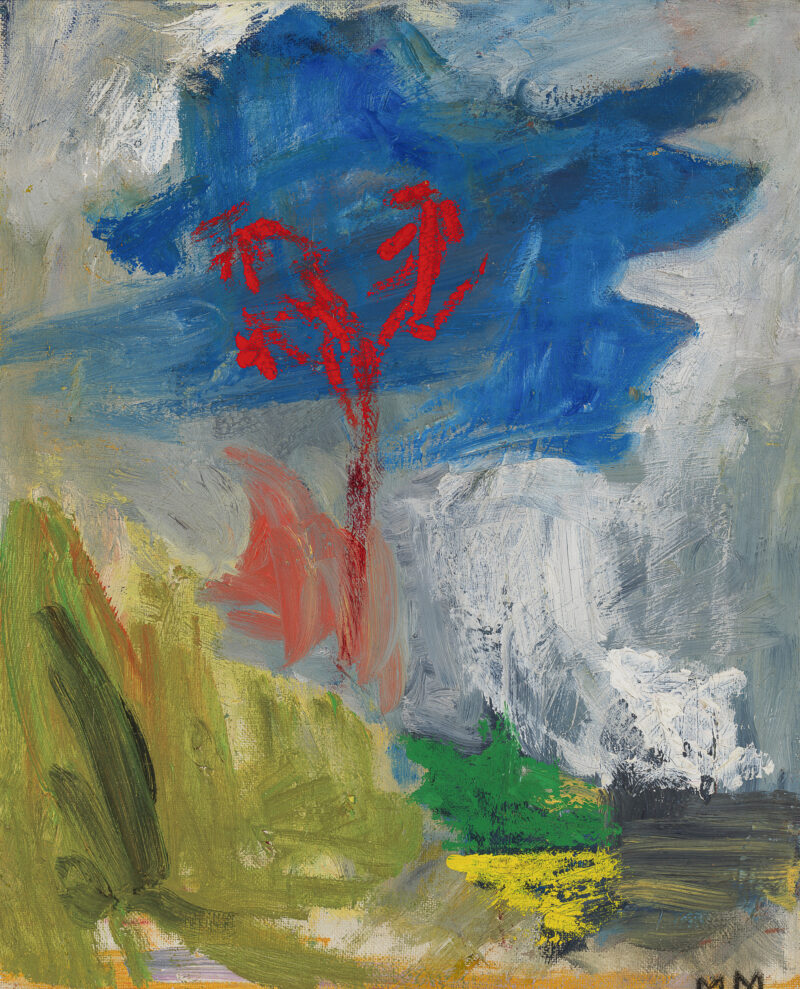
Mauno Markkula expressed his inner world through colour. He painted from imagination, using nature as a raw source of inspiration. As art historian Hilja Roivainen has noted, Markkula’s paintings have been described as intense colour visions, where colour and light together create a cosmic tension. Contemporary critics often called his colours garish or exaggeratedly emotional, though some also admired their lyrical harmony.
In both palette and handling of light, Lit Tree is more serene than Markkula’s fiery sunsets. Still, the bright red tree trunk stands in sharp contrast to the paler shades of the background and the muted foreground. A vivid blue sky adds further tension, serving as a counterpoint to the red, while the vigorous brushwork animates the scene throughout.
The painting belongs to the Leonard and Katarina Bäcksbacka Collection, donated in 1976 to the Helsinki City Museum, the precursor of HAM, Helsinki Art Museum. Leonard Bäcksbacka was an important patron of Markkula and regularly exhibited his work at his Konstsalongen Gallery on Helsinki’s Bulevardi.
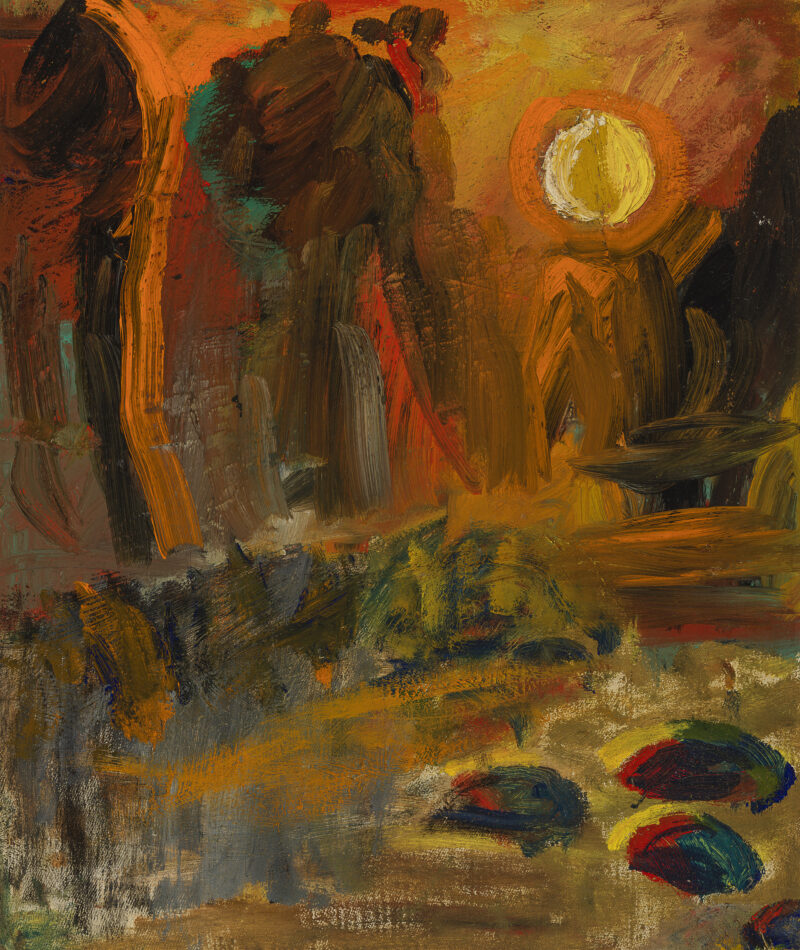
Text
Mauno Markkula sought knowledge and inspiration by travelling to Central Europe, particularly Paris. Each day, he visited art museums and studied the local architecture. His letters home offer fascinating insights into his experiences abroad.
In the early 1950s, Markkula wrote to his patron, the gallerist Leonard Bäcksbacka, noting that the art on display in Parisian museums had a fruitful influence on the Nordic imagination. He described painting imaginary visions in Paris as effortless – everything around him already seemed so picturesque. After the initial excitement, however, his letters took on a more sombre tone. Unaccustomed to the dusty streets of a large city, he longed for the light of Helsinki, which he described as crisp and logical. While Parisian architecture inspired him, he found the city’s natural environments sparse and tame.
Over time, the long journeys he undertook on foot or by metro began to take their toll. Even crossing a street seemed to sap his energy and inspiration. By then, he felt he had seen enough and gathered sufficient memories to work from for the summer, adding a quiet wish to leave the bustle of Paris behind and return to Helsinki.
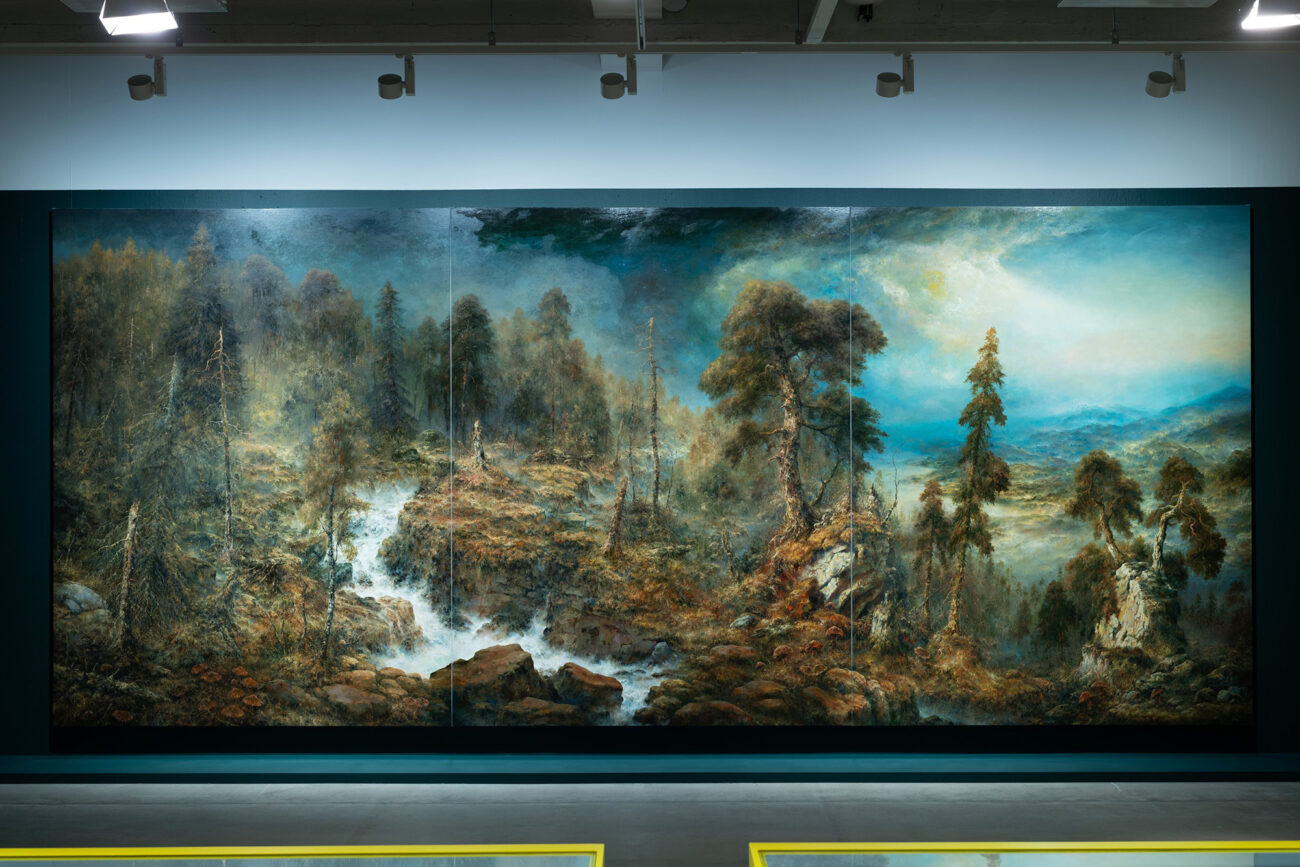
Text
Petri Ala-Maunus’s painting The Last Will was commissioned as the cover illustration for the novel Ylva by musician and author Marko Annala. The novel is set in 1980s Norway – the birthplace of black metal.
Ala-Maunus’s art is deeply influenced by both Norway’s mountainous landscapes and the aesthetics of heavy metal. Growing up amid the flat plains of South Ostrobothnia, the young artist dreamed of one day visiting a place of rugged natural grandeur. Album cover art offered a gateway to fantasy worlds: set against the subdued fields of his childhood, metal record covers presented electrifying visions of erupting volcanoes and untamed wilderness. As an adult, those distant dreams became reality when Ala-Maunus travelled to the mountains of Norway and Central Europe – journeys that left a lasting imprint on his landscape paintings.
To this day, music remains an integral part of his creative process, and he habitually listens to playlists while he works. While preparing for the Blazing Sky exhibition, music often filled his studio – from folk, rock, and pop to heavy metal, with occasional strains of electric organ and reggae.