
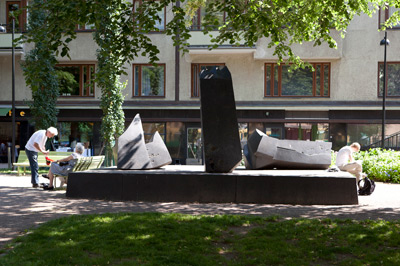
Divine Inspiration, Mika Waltari Memorial
Artist Veikko Hirvimäki
Mika Waltarin puisto, Etu-Töölö, Helsinki
In 1983, the Eteläsuomalainen osakunta, an association of university students from the south of Finland organized a competition for a memorial to the author Mika Waltari (1908-1979), an honorary member of the association. The competition was won by Veikko Hirvimäki’s (b. 1941) entry “Divine Inspiration” or “The Leading Thought’. The work consists of the pedestal (0.5 x 6.95 x 4.90 m) and three parts made of the black Jyväskylä granite. Including the pedestal, the highest point reaches 3.2 metres. Following the competition, the City of Helsinki decided in April 1984 to improve the park on the corner of Apollonkatu and Runeberginkatu and to name it after Mika Waltari, who lived on Tunturikatu, a street close to the park from the late 1920s until his death.
Even before its unveiling, Veikko Hirvimäki’s proposal caused extensive debate. Its non-figurativeness was considered perplexing by many, even degrading to Waltari’s work and the author himself by some. This criticism had a negative impact on the public’s willingness to donate to the collection arranged to finance the memorial. The work received as many interpretations as there were interpreters. Art historians and art critics underlined the variety of ways in which abstract art could be understood. Some connected the shapes of the work’s elements to Waltari’s life and texts. Surely, however, there is no single and correct interpretation of `The Leading Thought’; viewers see and understand it each in their individual way. The leading thought of the memorial is based on a quotation from Waltari’s novel ‘Turms kuolematon (Turms the immortal): “Ihmisessä itsessään ovat pisimmät matkat” (The longest journeys are within ourselves).
Hirvimäki started as a painter but is mostly known for his sculptures. He had his first exhibition in 1960 and is today represented in many international and Finnish museums.
The work belongs to the City of Helsinki’s art collection, which is managed and curated by HAM.